
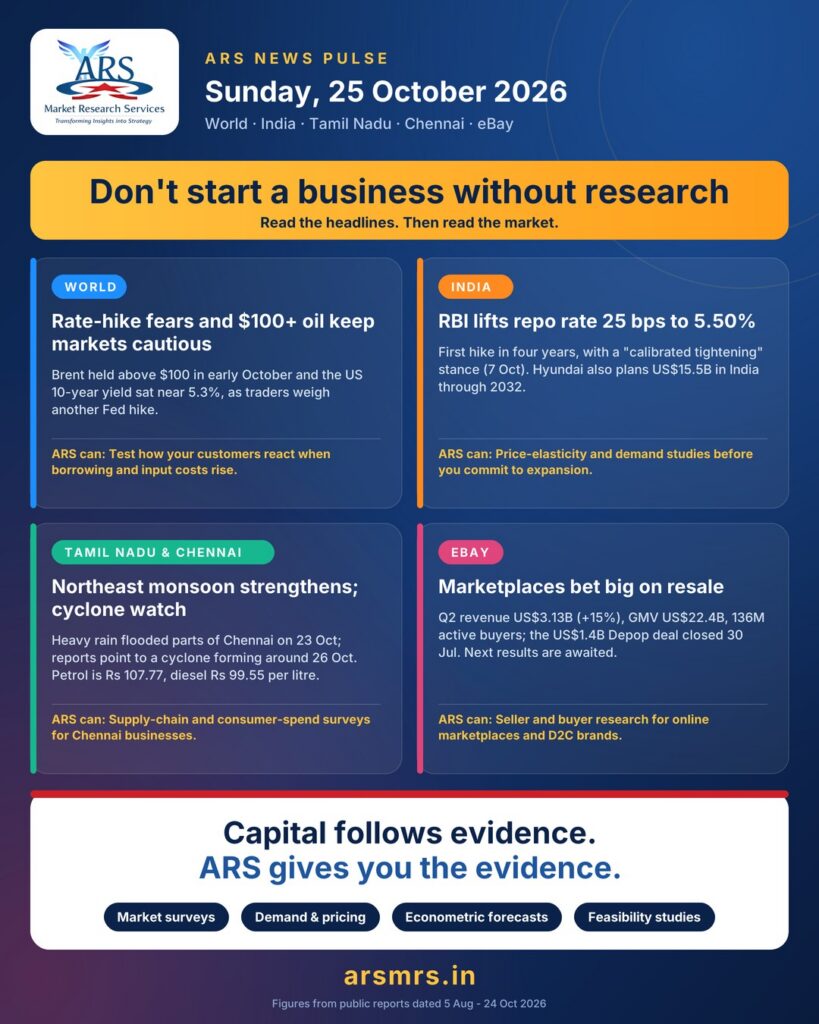
Every week brings headlines. Few business owners stop to ask what those headlines mean for their own customers. This note connects this week’s news to the research that turns it into a decision.
1. India: borrowing just got costlier
On 7 October the Reserve Bank of India raised the repo rate by 25 basis points to 5.50 per cent, its first hike in four years, and signalled a calibrated tightening stance. Separately, Hyundai has announced plans to invest US$15.5 billion in India between 2026 and 2032 for manufacturing and technology.
What it means: loans, working capital and consumer EMIs all become more expensive, while large manufacturers keep expanding. Small suppliers and consumer brands should check how sensitive their demand is to price before raising or cutting prices.
2. World: oil and rate-hike worries keep markets cautious
Brent crude traded above US$100 a barrel in early October and the US 10-year yield sat near 5.3 per cent, as investors weighed the chance of another US Federal Reserve hike. Higher energy and financing costs travel quickly into freight, packaging and retail prices.
3. Tamil Nadu and Chennai: monsoon and fuel costs
The northeast monsoon is strengthening. Heavy rain caused waterlogging in parts of Chennai on 23 October, and reports point to a cyclone forming around 26 October. Petrol is Rs 107.77 and diesel Rs 99.55 per litre, roughly Rs 7.5 higher than in mid-May. Retailers, food businesses and logistics operators should expect shifts in footfall, deliveries and cost of transport.
4. eBay and the resale boom
eBay reported second-quarter revenue of US$3.13 billion, up 15 per cent, with gross merchandise volume of US$22.4 billion and 136 million active buyers. Its US$1.4 billion acquisition of the fashion resale marketplace Depop closed on 30 July. Resale and recommerce are now mainstream channels, and brands that ignore them risk losing price-conscious customers.
The research to run before your next decision
- Price-elasticity study: how many customers will you lose if prices rise by 3, 5 or 8 per cent?
- Demand forecast: an econometric view of how rates, fuel and seasonality move your sales.
- Customer survey: what your buyers will cut back on first when costs rise.
- Channel research: whether online marketplaces and resale could add a new customer segment for you.
- Feasibility study: a clear go or no-go before you expand, borrow or launch.
Capital follows evidence. ARS Market Research Services gives you the evidence. To discuss a study for your business, write to admin@arsmrs.in.
Figures are taken from public reports dated 5 August to 24 October 2026 and may change.